Brand consistency is what makes every asset, in every channel, read as the same brand. To maintain brand consistency when multiple people create content for you, three things have to hold together. Everyone working on the brand understands what it stands for. The brand system is described in files the whole team can open, and someone keeps those files current. And all production goes through one standard, with art direction and review before anything is published.
Why is brand consistency important? Because people meet a brand many times and in many places, and each encounter either builds on the last one or starts from zero. A consistent brand gets more familiar with every touchpoint. An inconsistent one keeps introducing itself again.
Each of the three closes a gap the other two leave open. Files without understanding produce assets that follow every rule and still feel off. Understanding without files lives in a few people's memory. Both without review let the brand slide a little with every new asset. Most brand consistency challenges come down to one of the three missing, and brand drift is what it looks like over time.
This holds for a startup of twenty people and for a large company alike. Size changes how many channels, teams and assets are affected before anyone notices. The rest of this article takes the three in turn: what goes wrong without each one, and how it works once it's in place.
How to maintain brand consistency across channels
Picture a Black Friday banner. The person who ordered it looks at the draft and something feels flat. Could it be brighter? Maybe the brand colors are too quiet for a sale. Maybe a red background would make it pop. Each of these thoughts is reasonable. Each of them treats the banner as if it were the only thing the customer will ever see from the brand.
The customer, meanwhile, saw the brand last week in an ad, will get an email from it tomorrow and lands on the website the day after. If every one of those pieces was tuned on its own, every encounter starts from zero. Nothing builds on what came before.
Seasonal campaigns, launches and events are where brands bend the most, and bending is often the right call. The question is how far. A livelier version of one brand looks nothing like a livelier version of another. Guidelines can't answer that for every occasion. A team that knows why the brand looks the way it does usually can.
That's why we treat the brand's strategy, values and positioning as working material for the whole production team. The client shares them at the start and keeps sharing as they change. With that context, a designer facing a situation the guidelines never covered still knows what the brand would never do.
A brand system the whole team can open
A marketer needs a social post by the afternoon. The designer is busy, so the marketer opens the component library and builds the post themselves. The components are real brand components. They're just the ones made for a different kind of asset, and the post comes out slightly wrong in a way nobody can quite name.
Photography slips the same way. Finding an image that fits the brand takes time, so people use whatever is at hand. A designer new to the brand can follow every rule in the guidelines and still miss the tone, because the rules describe the brand and the reasons behind them live somewhere else.
A brand system that holds up is more than a logo and a palette. It's guidelines with examples of how each rule plays out in real assets, a component library, templates for recurring formats and design files organized so that anyone, especially someone new, can find how a thing was done before. On the accounts we run, all of it is described in files and kept in a shared Figma project that the client's team and its partners can open.
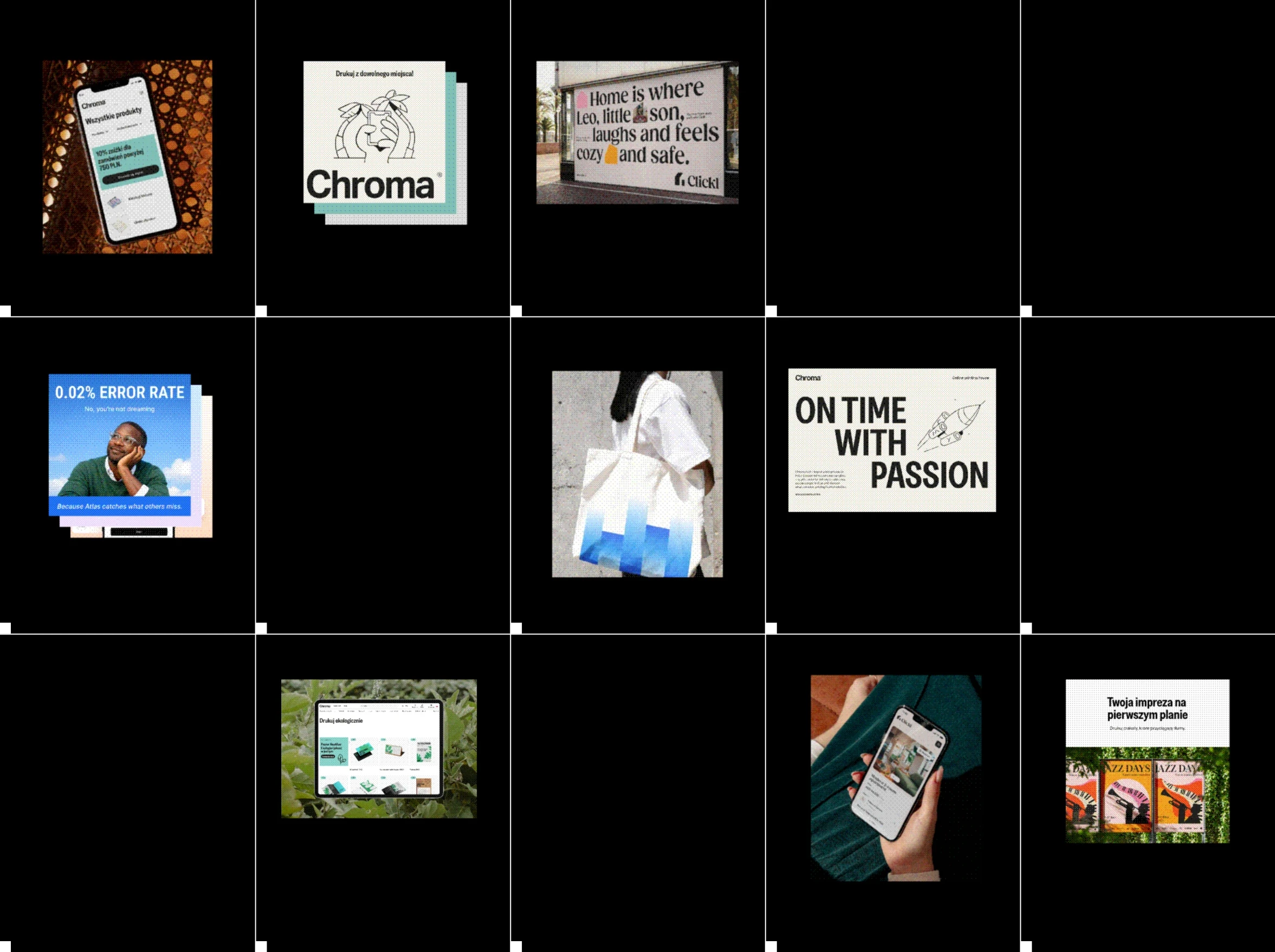
The system also has to grow with the brand. Once a brand produces at volume, it meets situations its guidelines never planned for. A designer flags a gap when the same question keeps coming back, or when it's clear the brand will face it again and it's worth solving properly now. They bring a proposal, review it with the art director, and the client approves the addition or agrees on a temporary solution. For Chroma, an online printing house, this is how motion became part of the guidelines after the rebrand. We proposed it ourselves as a new standard for the brand, so every animated asset that followed started from one set of rules.
Every addition goes into the files. A rule that exists only in someone's memory helps nobody who joins later.
How to maintain brand consistency across teams and partners
Many brands we meet have had a long line of people making their materials. In-house designers, freelancers hired per project, marketers assembling assets in Canva, developers filling gaps in the product. Each of them did reasonable work with what they had. If a source of truth existed, nobody kept it current, so everyone used the first file they found. Over time even type and color start to differ, and at some point the logo is the only thing two assets have in common.
On most accounts we run the brand's day-to-day design production. We make the assets, art-direct them and review them, and we keep the brand system in files current. A project manager plans the work together with the client's team. This is how we run marketing design for our clients.
Other people keep working on the brand as well, and that's normal. Developers build our designs. An in-house product team works on the interface. Another studio or a freelancer may take on a specific format. They all work from the same files, and while we're on the account, their output goes through the same review as ours. When the files are detailed, their questions are mostly clarifying ones. A shared base and a shared review are how you ensure brand consistency across teams that rarely sit in the same room.
New designers on our side come in the same way. A project manager, often together with a designer who knows the account, walks them through the brand, the client and how the work runs. They start from the current files and past work, with time set aside for questions.

They created a system that our internal designers and marketers could use as a foundation to build from.
Denny Hollick
Head of Product Marketing at Puzzle
How generative AI affects brand consistency
Generative AI raises the stakes for brand consistency on all three counts. It speeds up a designer who understands the brand and lifts the level of the work. In the hands of someone without that understanding, it produces slop: a stream of assets that look plausible and share nothing.
It can only work from what's described in files. A brand whose system, rules and decisions are already written down gives AI something real to work from. And whatever it produces needs the same art direction and review as everything else.
How to tell if brand consistency is working
Nobody gets a notification that the brand has become consistent. It shows up over time, and the clearest sign usually comes from outside the team, in the feedback the brand gets from customers, partners and the market.
The second sign is in the channels. When they speak one language, they bring in people who fit the same strategy. When they don't, different channels bring in very different people.
The third sign is internal. At some point the team looks back at materials from a year or two ago and sees how far apart they were. Often that comparison is the moment the people who did the work notice the change.
Where to start when your branding is already inconsistent
When we join a brand, the first weeks put the three things in place in roughly this order. It works just as well for a team doing it on its own.
Map who works on the brand and who gives the final approval. In most companies several people take part in the final decision, and it helps to know who they are before the first asset goes out.
Gather everything that exists into one source of truth: guidelines, brand documents, past design files. Some of it will be outdated, and sorting that out is part of the job.
Move the design files into one shared project everyone can open, organized by campaigns or by asset types, whichever matches how the team works.
Share the brand's strategy, values and positioning with everyone who produces assets, partners included.
Treat the first tasks as calibration. Ask where information is missing, fix the gaps in the files as they show up and route every asset through the same review.
If you want to see how this would work on your brand, here is how starting with us works.

COMMON QUESTIONS
You ask, we answer
Brand consistency is what makes every asset read as the same brand, whatever the channel or occasion. A consistent brand can be louder for a launch and quieter in a product email and still be recognized at a glance. It rests on three things: a shared understanding of the brand, a brand system described in files, and one standard for all production.
People meet a brand many times and in many places. When every touchpoint follows the same logic, each one builds on the last and the brand gets more familiar. When each asset is tuned on its own, every encounter starts from zero and the brand keeps introducing itself again. Over time the difference shows in how customers, partners and the market describe the brand.
Three things have to hold together. Everyone who creates content understands the brand's strategy, values and positioning. The brand system, from guidelines with examples to components and templates, is described in files the whole team can open and is kept current. And every asset goes through one standard, with art direction and review before it's published. Remove any one of them and the brand starts to drift.
On the accounts we run, we handle the brand's day-to-day design production and keep the brand system in a shared Figma project. In-house teams, developers, other studios and freelancers work from the same files. While we're on the account, their output goes through the same review as ours. Because the files are detailed, the questions partners bring us are mostly clarifying ones.
No single metric covers it. Three signs work in practice. Feedback from customers, partners and the market starts to describe the brand the same way. Different channels bring in people who fit the same strategy, where before they brought very different audiences. And when the team compares current materials with those from a year or two ago, the distance becomes obvious.
Generative AI raises the stakes on all three things that keep a brand consistent. It speeds up a designer who understands the brand and lifts the level of the work. Without that understanding it produces slop, a stream of assets that look plausible and share nothing. It can only work from what is described in files, and whatever it produces needs the same art direction and review as everything else.
You do, from the first file. Everything we create belongs to you, including components, templates and updates to the guidelines. We can work in your workspace or set one up for you, and you can take the files over at any time. That is also why the brand system lives in shared files that your team and partners can open.